
- Cranbourne Family CrewLocal concreters, no call centre
- Free Onsite QuoteMeasured, written, no obligation
- Built for Sand & ClayBase, steel and joints done right
- Clean, Finished WorkSite left tidy, slab cured right
Driveways for every kind of Cranbourne home
Cranbourne is really several suburbs in one. Around the town centre, Cranbourne Park and the racecourse you'll find brick veneer homes from the 1970s, 80s and 90s, many still on their original driveway. North of Thompsons Road the streets fill out with 1990s and 2000s family homes. To the east and west, new estates are still going up, with bare blocks waiting for a first driveway. And to the south the blocks get bigger and the driveways get longer. We pour concrete driveways across all of it, and each part of town has its own typical job.
In the older streets most of our work is replacement: breaking out a slab that has cracked into loose pieces, lifted around a tree, or sunk where the ground underneath has washed out, then pouring a new driveway with proper falls. On new estates it is the first driveway, usually with a crossover and often in exposed aggregate to suit modern facades. On acreage in Cranbourne South it is long driveways, turning areas and hardstand for trailers. Whatever the job, the way we build the slab underneath is the same.
How we build a Cranbourne driveway
A concrete driveway is only as good as what's under it and what's inside it. Here is our standard build, step by step:
- Set out and excavate. We mark the shape with string lines, set levels from the garage slab and the kerb, and dig out topsoil, roots and soft material to firm ground.
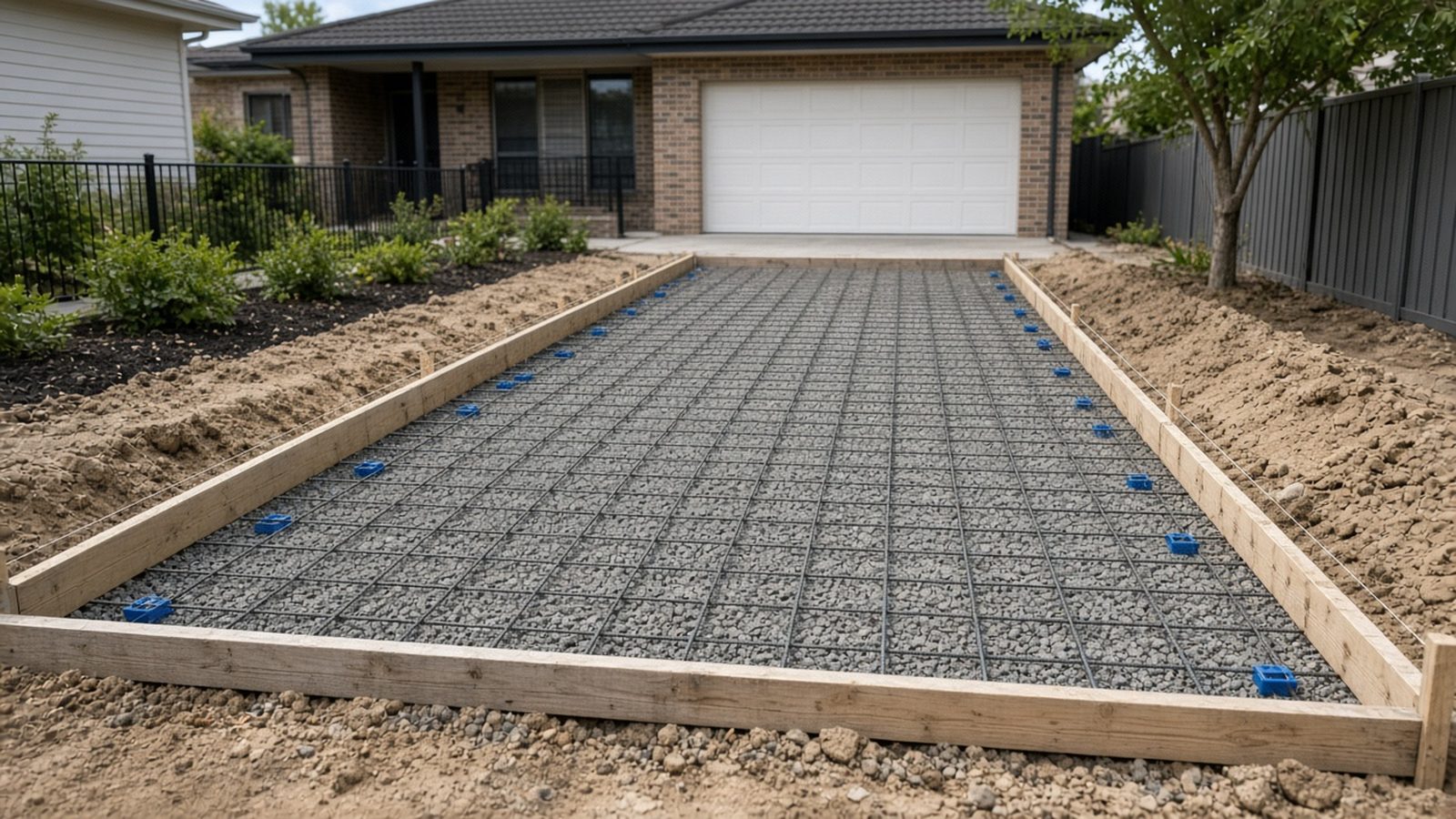
- Base. A crushed-rock base goes in and is compacted with a plate or roller. On sandy blocks we keep it a little wider than the slab so the edges are supported; on clay we make sure water won't sit on the subgrade.
- Formwork. Timber or steel forms are set to height and fall. Falls are usually around 1 in 100 or more, steered toward the street, a grated drain or the garden, and away from the house.
- Steel. Reinforcing mesh, typically SL72 or SL82 for a car driveway, is placed on bar chairs so it ends up in the middle of the slab. Laps are tied, and extra trimmer bars go in at corners and pits.
- Pour and finish. Concrete arrives from a local plant, is placed by chute, barrow or pump, screeded, floated and finished in your chosen surface.
- Joints. Isolation joints go against the house, the garage slab and the crossover. Control joints are saw-cut within the first day, generally at no more than about 3 to 4 m apart on a single driveway, closer on narrow sections.
- Cure and seal. The slab is kept moist or treated with a curing compound so it gains strength evenly. Coloured, exposed and stamped finishes are sealed once cured.
Thickness and reinforcement
For a normal family driveway carrying cars and SUVs we pour 100 mm minimum. If a caravan, boat, trailer or work truck will park on it, or a delivery truck will regularly reverse in, we go to 125 to 150 mm in those areas and step up the mesh. We'll ask what will be using the driveway at the measure and price the heavier sections only where they're needed.
Finishes we pour
| Finish | What it is | Why people choose it |
|---|---|---|
| Plain broom | Natural grey concrete with a brushed texture | Hard-wearing, grippy, easy to repair; ideal for long driveways and sheds |
| Steel trowel / honed | Smooth, dense surface | Clean modern look for garages and covered areas |
| Coloured | Oxide colour mixed through the concrete | Matches render, brick and roof colours; no grey core when chipped |
| Exposed aggregate | Surface washed back to reveal the stones | Great grip, hides marks, the most popular new-build finish |
| Stamped / stencilled | Pattern pressed or sprayed into coloured concrete | Looks like slate, cobbles or pavers without loose units |
Drainage: the part people forget
Water is behind most driveway problems we see around Cranbourne. A driveway that falls toward the garage sends stormwater under the door. One that sheds water onto the side of the house wets the footings and, on clay, starts the slab and the house moving. Water that ponds against the edge of a slab on sandy ground slowly washes the base out. We set falls so water goes where it should, add a grated channel drain across the garage entry or at the low point where needed, and connect it to your legal point of discharge.
Working with builders and landscapers
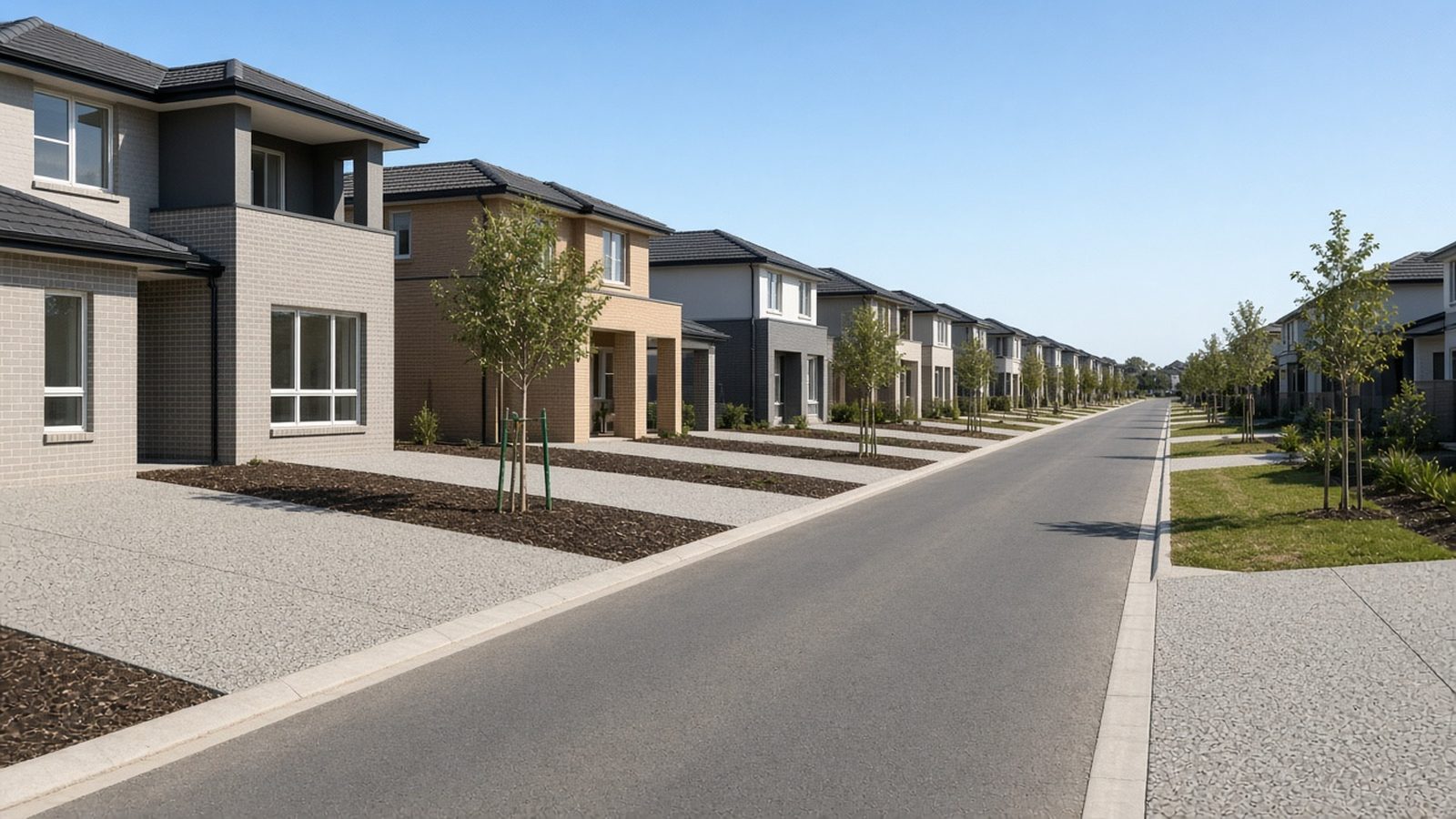
On new homes in Cranbourne East, Cranbourne West and Botanic Ridge we often pour after the builder's handover and before the landscaper. We'll check the builder's site cut, the garage slab height, the position of pits and services, and any estate design rules on colour and finish. Getting the driveway levels set first gives the landscaper fixed heights to finish paths, garden beds and lawn to.
What affects your quote
We don't put prices on the website because no two driveways are alike. The main things that change your quote are the size in square metres, the finish, removal of any old concrete, how much soil needs to come out, ground conditions, access for the truck or pump, the crossover, and any drains or steps. Our cost factors guide walks through each one. The quote you get after the measure is written and itemised, so you can see what's included.
How It Works
From first call to a cured driveway
Ring or send the form
Tell us the suburb, the job and roughly how big it is. One of the crew rings back to book a time.
Onsite measure
We measure the area, check levels, falls, ground, access and the crossover, and show you finish samples.
Written quote
A clear written scope: removal, excavation, base, steel, finish, joints, sealing and clean-up.
Pour, cut and cure
Forms and steel go in, we pour and finish, saw-cut the joints and leave the slab curing behind tape.
Questions
Frequently asked questions
How long does a new driveway take?
Most single and double driveways take two to four days on site: a day to excavate and form up, a day for steel and the pour, and time for saw-cutting and clean-up. Removal of an old slab adds a day. Weather can push the pour back; we won't pour into heavy rain.
Do you remove the old driveway?
Yes. Break-out, loading and carting away the old concrete is part of our replacement quotes, and the concrete is taken for recycling where possible.
Can you match a new driveway to my existing path or crossover?
Usually. Plain concrete is easiest. Coloured and exposed aggregate can be matched closely but never perfectly to concrete that has weathered for years, so we often suggest a neat joint or border where old meets new.
Why does concrete crack?
Concrete shrinks as it dries, and the ground under it moves. Control joints give that movement a neat place to go. Fine hairline cracks between joints can still appear and are normal. Wide, stepped or lifting cracks usually point to a base, drainage or thickness problem.
Do I need to be home on the day?
Not for the whole day. It helps if you're around at the start of the pour to confirm the finish and levels, and you'll need to keep cars, pets and kids off the fresh concrete.
Service Areas
Concreters for Cranbourne and the suburbs around it
Free Quote
Get a free quote for your driveway
Send the form and one of our Cranbourne crew will ring you back to book a free onsite measure. You get a written quote that spells out exactly what is included, with no obligation.
- Cranbourne, Cranbourne North, East, West and South, Lyndhurst, Sandhurst, Lynbrook, Hampton Park and Botanic Ridge
- Driveways, replacements, crossovers, exposed aggregate, coloured and stamped concrete, slabs, paths and patios
- You deal with the people who pour your concrete
Rather talk it through?
03 7074 8264Request Received
Thanks ! Someone from Cranbourne Concrete Driveways will call you back shortly to book your free onsite measure. For emergencies right now, please call us directly.
Call 03 7074 8264Driveway looking tired?
Book a free onsite measure anywhere around Cranbourne.