
- Cranbourne Family CrewLocal concreters, no call centre
- Free Onsite QuoteMeasured, written, no obligation
- Built for Sand & ClayBase, steel and joints done right
- Clean, Finished WorkSite left tidy, slab cured right
Two kinds of ground in one suburb
Few places in Melbourne's south-east change underfoot as much as Cranbourne. South and west of the town, through Cranbourne South, Cranbourne West, Botanic Ridge and Sandhurst, much of the ground is sandy: part of a broad sand belt that has been quarried around Cranbourne for generations and that supports the heathland protected at the Royal Botanic Gardens Cranbourne. North and east, through parts of Cranbourne North, Cranbourne East, Lyndhurst and Hampton Park, you're more likely to hit reactive clay. And on new estates, both may be buried under fill.
Every driveway failure we're asked to fix around Cranbourne traces back to the ground, the water, or what was skimped underneath. Understanding your ground is the first step to a driveway that lasts.
Sandy ground
What it's like
Sandy soils drain freely and don't swell and shrink much with moisture, which is good news. But loose sand compresses under load if it isn't compacted, and it can move sideways from under an unsupported slab edge, especially when water runs along the edge or a garden bed is constantly irrigated.
Typical failures
- Edges cracking or dropping where wheels run close to the side
- Settlement over loosely backfilled service trenches
- Cracks beside garden beds where sand has washed out
How we build on sand
- Compact the subgrade in layers, at the right moisture
- Lay a crushed-rock base extending past the slab edge
- Thicken edges on driveways where wheels run close
- Keep downpipes, irrigation and garden-bed water away from the edges
Reactive clay
What it's like
Reactive clays swell when they get wet and shrink as they dry. Over a Melbourne year, a wet winter and a dry summer, the ground under a driveway can move up and down noticeably, and unevenly: wetter near garden beds and leaking pipes, drier near trees and under the middle of the slab.
Typical failures
- Cracks running across the slab, often widening over the years
- Panels tilting or lifting near trees
- Gaps opening between the driveway and the house or garage
How we build on clay
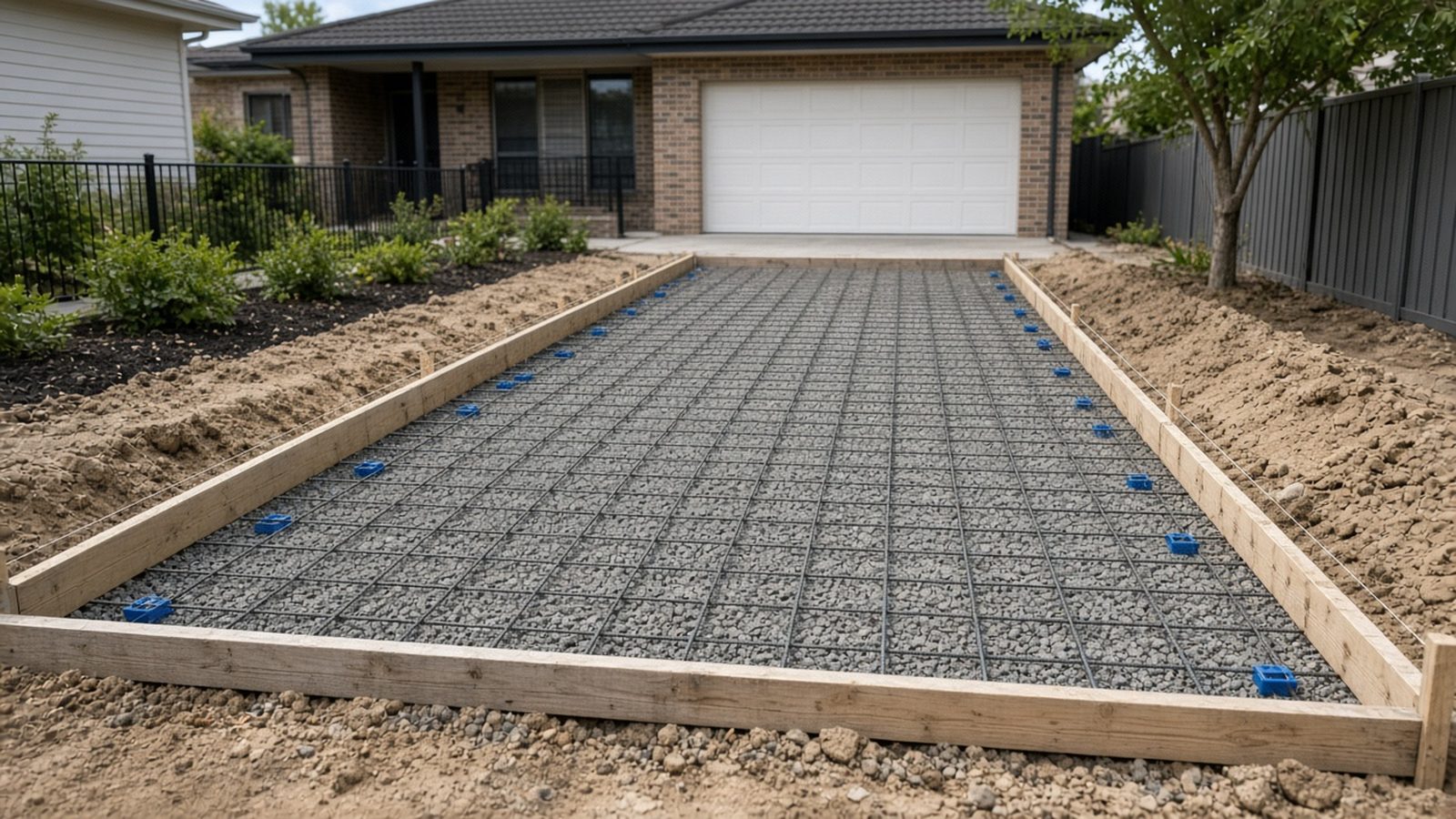
- Remove topsoil and soft clay to firm ground and add a compacted crushed-rock base
- Keep water off the subgrade with good falls and drainage
- Pour 100 mm minimum with mesh on chairs, thicker for heavy vehicles
- Cut control joints closer together so movement cracks along neat lines
- Use isolation joints at the house and garage so they move independently
- Consider a membrane under the slab on very wet or reactive sites
New estate fill
On new estates the top of the ground may be neither sand nor clay but fill: soil moved around to level the subdivision. Fill settles over time, and the trenches for water, sewer, stormwater, NBN and power under your driveway are often the softest spots. We probe the area, dig out soft trench backfill and re-compact it before we pour. See Cranbourne East and Cranbourne West.
Water is the common enemy
On sand, water washes the base out from the edges. On clay, water makes the ground swell unevenly. Either way, good drainage is the cheapest insurance a driveway can have: falls away from the house, downpipes connected to stormwater rather than spilling onto the driveway, grated drains at low points, and garden beds that don't hold water against the slab.
How we check your ground
At the measure we look at the soil exposed in garden beds and around the existing slab, how old cracks behave, where water goes, and nearby trees. On new homes the builder's soil report (the site classification on your building paperwork) is a big help, so have it handy if you can.
How It Works
From first call to a cured driveway
Ring or send the form
Tell us the suburb, the job and roughly how big it is. One of the crew rings back to book a time.
Onsite measure
We measure the area, check levels, falls, ground, access and the crossover, and show you finish samples.
Written quote
A clear written scope: removal, excavation, base, steel, finish, joints, sealing and clean-up.
Pour, cut and cure
Forms and steel go in, we pour and finish, saw-cut the joints and leave the slab curing behind tape.
Questions
Questions
What is a site classification?
Before a house is built, the soil is tested and given a classification for how reactive it is. It's on your building paperwork and helps us understand your ground.
Is sand or clay better for a driveway?
Both can carry a long-lasting driveway if it's built for the ground. Sand needs compaction and edge support; clay needs good drainage, steel and closer joints.
Can trees crack my driveway?
Yes. Roots lift slabs directly, and on clay, trees dry the soil and cause shrinkage. We plan around trees and use root barriers where appropriate.
Does a thicker slab stop cracking?
Thickness helps strength, but cracking is controlled mainly by the base, steel position, joints and drainage.
Service Areas
Concreters for Cranbourne and the suburbs around it
Free Quote
Get a free quote for your driveway
Send the form and one of our Cranbourne crew will ring you back to book a free onsite measure. You get a written quote that spells out exactly what is included, with no obligation.
- Cranbourne, Cranbourne North, East, West and South, Lyndhurst, Sandhurst, Lynbrook, Hampton Park and Botanic Ridge
- Driveways, replacements, crossovers, exposed aggregate, coloured and stamped concrete, slabs, paths and patios
- You deal with the people who pour your concrete
Rather talk it through?
03 7074 8264Request Received
Thanks ! Someone from Cranbourne Concrete Driveways will call you back shortly to book your free onsite measure. For emergencies right now, please call us directly.
Call 03 7074 8264Driveway looking tired?
Book a free onsite measure anywhere around Cranbourne.